Monday, April 7, 2014

Posting 9
Reverse logistics Flow Process

Characteristics of reverse logistics

The reasons for returning products can be distinguished by where the returns initiated. Listed below are the main return reasons for each supply chain partner.

Customer not satisfied
Most manufacturers and retailers allow customers to return products if they do not meet their demands within a predefined period. Moneyback guarantees are standard practice for most direct sales channels. Consumers and retailers will sometimes abuse the return policies of manufacturers. Consumers wanting to try a new product will sometimes abuse the ‘not satisfied, money-back’ guarantee and simply return the product within allotted return period and receive their money back.

Installation or usage problems
Some customers experience problems with installation or usage of their recently acquired products. They perceive the product to be defective, while the reason for dissatisfaction is actually caused by difficult set-up or installation procedures or unclear instructions. This is a common problem in the computer industry where in some categories such as CD-ROM drives, return rates of 25 to 40 per cent are not uncommon. Complicated installation procedures and a lack of clear and simple instructions exacerbate the issue.

Warranty claims
Defective products or parts can be sent back to retailers or the manufacturer for repair. Products might either be dead on arrival, not working according to specifications or cosmetically damaged. This could happen either to the retailer or the end consumer. Alternatively, products might break down during the course of their life cycle. If the product is still within the warranty period extended by the manufacturer customers might return their product to the manufacturer or if that period has expired, customers could take up other options such as taking the product to a specialist repair center.

Faulty order processing
Both end consumers and retailers can experience shipping problems. Products need to be delivered in full and on time or customers can make claims against manufacturers and return (part of ) their shipment. Examples of delivery problems are incomplete shipments or missing parts, wrong quantities, wrong products, duplicate shipments and untimely delivery, which can cause the customer to miss out on the intended use of the product.

Retail overstock
Manufacturers can provide resellers with the luxury of returning unsold stock. This is a common practice in the book industry, for example. Retailers that need to make their accounting figures look good for the end of quarter or month will sometimes send significant
amounts of unsold stock back for credits, only to reorder it again after the end of a financial period.

End of product life cycle or product replacement
Once a product has reached the end of its life cycle, many manufacturers want to get it out of the retailers’ shelves as soon as possible to prevent sales cannibalization of the new version. This means that the old products have to be disposed of. Manufacturers either have to take the stock back, based upon the conditions agreed with the retailers, or the latter need to dump the old version quickly.

Manufacture recall programs
Serious flaws in a product can lead to a recall, instigated either by the manufacturer or a government agency. Common recalls appear in the automotive, pharmaceutical, and the toy industry. Aside from the safety issues in such situations, getting the discredited product out of circulation and into designated storage centers as soon as possible is a crucial part of damage limitation strategies. It is a grim deadline that any company would prefer not to have to meet, but many do. The US Consumer Product Safety Commission in 1999 reported 304 corrective actions involving over 75 million consumer product units of various types that either violated mandatory safety standards or presented a substantial risk of injury to the public.

Attacking the returns challenge
Improving the process : The four key steps involved in a returns process are local screening,
collection, sorting and disposition

·         Local screening
Local screening is done at the point of collection of the returned products. Often products enter the supply chain that should not enter in the first place and cause unnecessary transportation, administration and handling costs. In an ideal reverse supply chain, products are screened at the point of collection according to specifications of the manufacturer. Disposition, however, changes based on the product (or its version), the vendor and the retailer. Therefore, complex decision mechanisms need to be maintained to allow disposition of product based on customer agreement on a product-by-product basis. With the ubiquitous presence of the Internet plenty of opportunities exist to do this in a cost efficient and effective way. This will be discussed in more detail in the Technology section.

·         Collection
There are many different ways to collect the products that are destined to enter the reverse supply chain. Retailers often have to send their return products back to their suppliers’ different warehouses throughout the country. Different processes need to be set up to facilitate timely processing of these returns. This can often be very complicated and confusing for both retailers and manufacturers as they are dealing with multiple parties, many of whom are concentrating on getting products out to the customer, rather then back to the source. Some companies have set up central collection centers for collecting and sorting returns, which have proven to be very effective.

·         Sorting
Some large retailers have been using centralized return centers (CRCs) for many years. They have selected centralized return centers dedicated to handle their entire reverse logistics operations. The advantages of using centralized return centers are numerous. When a company dedicates an entire facility, organization and system to optimize the handling of returns, benefits arise from a whole range of areas. Some of the key benefits are: efficiency can increase as employees occupy positions full-time and can focus on handling returns only, experience in the sorting process will help employees make better and quicker disposition decisions, and cycle times will improve, resulting in better asset recovery and higher customer satisfaction.
        o   Sell as-is:
        resale (as new)
        sell via outlet or discount store
        e-auction, and
        sell to secondary market

o   Repair or reuse:

        repair
        refurbish or re manufacture
        modify and
        recycle

o   Dispose:

        scrap
        donate (to charity), and
        dispose in secure manner (for example, certain drugs).

Disposition should be done to maximize the value of reclaimed goods or dispose of the goods in the most cost-effective way. Below are some innovative ways leading practice companies have adopted to improve the disposition of their returned items. Successful reverse logistics projects

Throughout this chapter many companies have been named that have engaged in one way or another successful reverse logistics projects.A good example complete reverse logistics program is a project by cosmetics manufacturer Este´e Lauder.The firm used to dump $60 million of its products into landfills each year, destroying more than third of the name brand cosmetics returned by retailers. Este´e Lauder made a small investment of $1.3 million to build its proprietary reverse logistics system of scanners, business intelligence tools linked to an Oracle database. The company has apparently recovered its investment in the first year through reducing labor and other costs.

                   Este´e Lauder has reduced its production and inventory levels through its increased ability to put returned goods back on the market and the availability of better data on the reasons for returns. In the first year Este´e Lauder was able to evaluate 24 per cent more returned products, redistribute 150 per cent more of its returns, reduce the
destroyed products from 37 per cent to 27 per cent and save about $0.5 million in labor costs. After implementation, Este´e Lauder even considered making the system commercially available through a consulting firm that could serve as a reseller of the software.When companies decide to embark on a reverse logistics project they can leverage knowledge, tools and processes from other successful projects such as Este´e Lauder’s, to prevent them from reinventing the wheel. Together with specialist service providers in the reverse logistics arena, significant improvements can be made to reduce costs, improve customer service and increase revenues.


Saturday, April 5, 2014

Posting 8


Radio frequency identification (RFID) System


Radio frequency identification (RFID) is a generic term that is used to describe a system that transmits the identity (in the form of a unique serial number) of an object or person wirelessly, using radio waves. It's grouped under the broad category of automatic identification technologies. For the universal term given to any technology that uses radio waves to identify and track items. Items such as a product, a container, an automobile, an animal, or a person can all automatically identified and tracked by RFID technology

Auto-ID technologies include bar codes, optical character readers and some biometric technologies, such as retinal scans. The auto-ID technologies have been used to reduce the amount of time and labor needed to input data manually and to improve data accuracy.

Some auto-ID technologies, such as 
bar code systems, often require a person to manually scan a label or tag to capture the data. RFID is designed to enable readers to capture data on tags and transmit it to a computer system without needing a person to be involved.

Advantages of RFID

Inventory Shrinkage Reduction 
• Track retail items between point of manufacture or purchase from supplier and point of sale.
• Real-time notification of security when RFID tagged items leave area without payment
• Saving money on theft allows to offer product at lower prices

RFID Smart Labeling
• Monitor unattended inventory
• Automatic item identification on mixed pallets
• "Smart Shelf" systems that are designed to provide real time tracking and locating of tagged items on shelves
• Shipping and Receiving applications

Shelf Stocking
• Real-time notification of stock out  items
• Improvement of product replenishment
• Retention of consumers who may turn to competitors if inventory item is out-of-stock
• Automated charting and tracking for improved product forecasting

Check-out Process 
• Reduce time spent in line production
• Reduce labor or time cost of employees
• Streamline check-out process with ability to scan multiple items and pay for them all at once

Overhead Reduction
• Track product shipping and receiving from point-to-point automatically versus manual tracking to save time and labor cost
• Know how many units of inventory or on-site via automated RFID system versus manual process, saving labor and time cost
• Efficiency in error reduction reduces manual labor cost


Disadvantage of RFID


·Expense

RFID systems are typically more expensive than alternatives such as barcode systems. While passive tag reading is similar to (and generally less expensive than) barcode reading, active tags are costly due to their complexity. Active tags consist of an antenna, radio transceiver and microchip, increasing the overall cost of an RFID system.
·Collision
Tag collision and reader collision are common problems with RFID. Tag collision occurs when numerous tags are present in a confined area. The RFID tag reader energizes multiple tags simultaneously, all of which reflect their signals back to the reader. This results in tag collision, and the RFID reader fails to differentiate between incoming data. RFID reader collision results when the coverage area managed by one RFID reader overlaps with the coverage area of another reader. This causes signal interference and multiple reads of the same tag.
·Security
RFID technology gives rise to numerous security concerns. Since the system is not limited to line-of-sight, external (and malicious) high-intensity directional antennas could be used to scan sensitive tags. Fraud is always a possibility when the technology is used for high-security operations, such as payment verification
Posting 7


Top 5 Challenges Faces in Purchasing and Supply

1.  Cinderella must win ball
The economic downturn has helped procurement get more spend under management, but there are still widespread variances in organisations’ degree of maturity around implementing and enforcing formal category management procedures.“Even leading organisations still find some categories difficult,” says Michael Lewis, professor of operations and supply management at the University of Bath. “We still don’t have a handle on the buying of services in the same way as we do products.”A further challenge is around linking any savings procurement claims to have made to the bottom line. “You can get compliance, but those results are then used differently and you still don’t see it in your profit and loss,” says Kris Timmermans, global procurement lead at Accenture. “The reporting of £100 million of savings which nobody sees is unsustainable.”Despite its higher profile, procurement also has to fight for recognition in the wider business, particularly at board level. “It remains puzzling why procurement continues to be a Cinderella function in comparison to other areas,” says Jim Abery, partner, commercial excellence, at Ernst & Young.To change this perception, procurement needs to demonstrate it can contribute to the top line as much as the bottom, he says, as well as developing the leadership skills needed to act as a strategic partner to the business and 60% of spend achieved for most procurement functions .

2. Risks on company radar
Risk remains very much front of mind for procurement, particularly around the possible implications of supplier failure and natural disasters. This has partly been due to the recession and events such as Hurricane Sandy in the United States, but also because organisations have woken up to the fact that they now operate in a much more globalised environment, says Professor Lewis. “Clearly if you operate a global supply chain, you have a different risk portfolio than if you operate in the south-east of England,” he adds. Other risks are now appearing on procurement’s radar, says Mr Timmermans, including how to cope with commodity price volatility. “For many of the processing manufacturing industries, the speed with which the commodity prices go up and down is unseen,” he says. “A number of our clients are working with Treasury to set up commodity pricing risk management capabilities.”

Managing reputational risk from the wider supply chain is also on the agenda, particularly in the wake of the horse-meat scandal. Increasingly, he says, procurement needs to be able to monitor quality throughout the entire chain, rather than just tier-1 or 2 suppliers, if it is to avoid being caught up in controversial areas such as child labor, conflict minerals or palm oil plantations and 25% of procurement functions have only a basic level of maturity around risk management.

 3. Sustaining ethics boosts bottom line
Sustainability itself is challenge procurement must get to grips with. Rather than seeing this purely as a risk, though, leading organisations will view it as a source of competitive advantage, says Carlos Mena, director of the Centre for Strategic Procurement and Supply at Cranfield School of Management, and procurement has a pivotal role to play here. “Companies that are really forward-looking can brand and market what they’re doing in their supplier base around sustainability, whether that’s rooting out child labour, reducing CO2 emissions or engaging with second and third-tier suppliers,” he says. Unilever is a good example here, he adds; around 70 per cent of its sustainability initiatives are directly related to the supply chain and, over a five-year period, tackling these has made money for the business. “They have shown how you can contribute to the top line by taking care of both the environmental and social issues in your supplier base,” he says. However, Professor Lewis believes social and ethical sustainability will only be a focal point for those organisations that choose to compete in this way, with environmental sustainability likely to be the main focus for most procurement functions on account of resource scarcity and cost of raw material. “The risk around environmental materials is shifting so we will behave differently in the way we purchase and use them,” he says. “81% of procurement professionals planned to ask suppliers for more information on sustainability in 2012”

4. Dawn of social-media technology
Technology is set to fundamentally change the way in which procurement operates over the next few years, says Gerard Chick, chief knowledge officer at Optimum Procurement.
This will be led mainly by the rise of networks built around social media technology, which will enable procurement professionals to stay up to speed on industry developments and interact with multiple-tier suppliers all around the world. “We are at the dawn of instantaneous business intelligence,” he says. “It starts to bring visibility, so proper open-book pricing and transparency.” The development of such platforms means procurement will increasingly be able – and expected – to make decisions based on research and the use of predictive data, says Mr Chick, including using analytics to predict periods of peak and low demand to help with buying decisions. Ultimately, this will change the skill-set required for those working in procurement. “Procurement people will need to be two things in the future,” he says. “They need to be analyzers, who know what’s happening in the places where they work, but they will also need to be able to delve around and bring issues to the fore in a business. In the future we won’t need buyers; we’ll need people who understand markets and can be the ones the rest of the business goes to.” Over 45% of procurement functions have an established level of maturity in use of technology and systems.

5. Headhunting talent for new role

Attracting fresh talent into the industry is likely to be a core focus for procurement functions as the skills required by procurement professional’s change. “If you want to engage better with the organisation and show that procurement can add to the top line you need a different breed of people,” says Dr Mena. Softer skills in particular will be required as buyers increasingly need to influence those outside the procurement function. “People with a good emotional IQ tend to go to other functions, so the issue is how we can attract these people,” he says. “It’s about recruitment rather than training and development because softer skills are much more difficult to teach.” Companies should be thinking of partnering with industry bodies and schools to offer top young talent a route into the profession that may not involve going to university, says Mr Chick. Organisations will also have to wrestle with how much of an in-house procurement presence they want to have, says Professor Lewis, as many look to outsource procurement activity to third parties. “What is a critical mass for procurement in a firm which has decided not to do that in-house?” he asks. “It’s an interesting dilemma going .

Sunday, February 23, 2014

Posting 6


JIT SYSTEM IN DELL

For nearly three decades, Dell has been on an incredible journey, experiencing positive growth on a global scale. Through it all, it's our people(customers), business partners and team members (who keep us moving through the rapidly evolving world of technology).

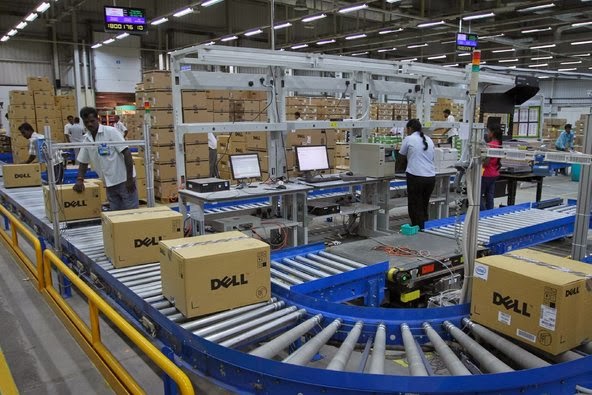
Dell has also leveraged  JIT principles to make its manufacturing process a success. Dell’s approach to JIT is different in that they leverage their suppliers to achieve the JIT goal. They are also unique in that Dell is able to provide exceptionally short lead times to their customers, by forcing their suppliers to carry inventory instead of carrying it themselves and then demanding (and receiving) short lead times on components so that products can be simply assembled by Dell quickly and then shipped to the customer.

Dell pioneered a new way of making and selling computers. Dell re-engineered its supply chain so that it could produce computers with the exact features that customers ordered, ship them within 24 hours of taking the order, and ultimately invest almost no money in inventory. What does JIT Inventory mean? Small amounts of product are held in inventory. This means, at any given time, Dell would have little to no products wasting time in inventory. Essentially, products would be produced as they're demanded and to the customer's specifications. Dell thereby enabled customers to build almost completely custom-made computers. This increased customer satisfaction and loyalty.

Build to Order .
At Dell, the process is called "pull to order,”. It’s a critical element of our build-to-order manufacturing process,". The model contributes to increasing the accuracy of doing business, both from a customer and supplier standpoint. Once the parts are delivered, the assembly-line process can begin prepping components. Dell then begins manufacturing the actual computer.  Afterward, it tests and does custom integration work for the finished product.

After getting an order, Dell notifies its suppliers about what components are needed, and they're delivered within an hour and a half. With our pull-to-order system, we've been able to eliminate warehouses in our factories and have improved factory output by double by adding production lines where warehouses used to be. Dell generally fulfills customer demands within five days, and the firm plans to reduce that time by relying on more extensive Web-based collaborative technologies.

In addition to the manufacturing efficiency, there are other reasons why build-to-order is appealing. For instance, it helps prevent manufacturers from being stuck with inventory that may become obsolete as it sits gathering dust in a warehouse, says Burkett. Or if there's a design change to a manufactured product, a company can be stuck with useless inventory that it has to dispose of at a loss.
Process

Upon implementation of the world wide technology (WWT) solution, WWT became the single partner providing resources on the factory floor, reducing the overall number of resources required to maintain continuity of supply. WWT also built a dedicated team of material planners, vendor managers and process consultants to ensure end-to end management and efficiency of the solution. WWT brought several process and technical innovations to the Dell team. First, WWT developed a suite of forecast, inventory and demand planning applications calibrated to fluctuations in Dell's manufacturing process. Second, WWT opened distribution centers collocated with each Dell factory reducing lead times to 45 minutes or less. Finally, implementation of a RF based bar code scanning system used for product acceptance, replenishment requests and invoice reconciliation at the factory floor. These innovations while removing cost also provided much greater visibility and reliability relative to continuity of supply. 

Key to the WWT solution was working with each of the legacy suppliers.Management of 40 suppliers with 40 different processes and systems was a key challenge that the team faced. Leveraging technology, the WWT team was able to provide an integrated process for each supplier to receive orders, monitor forecast and reduce personnel cost. Also, by reducing entry barriers for suppliers wanting to work with Dell, WWT has been able to introduce a new level of free market competition further reducing stock keeping unit (SKU) prices for individual 
components managed by WWT. WWT successfully developed the needed systems, opened three initial facilities and put together a support team in just under three months. In addition, the project went live just prior to the holiday season, which is typically the most critical time of year for Dell's business. 

A member of Dell's supply chain management team noted, “Our new program with WWT has created new efficiency and simplicity in our supply chain. Consolidating supply chain management with a single entity has eliminated a lot of waste.” Dell has been able to acknowledge savings across multiple business areas recognize overall SKU price reductions and experience a scrabble process necessary to support Dell's overall growth. Since the program began in 2003, WWT has added three additional distribution centers, added more than 50 suppliers, built a team of more than 100 people to support Dell and is expanding into Dell's international manufacturing facilities.


(WWT) : World wide technology.

(SKU)   :Stock keeping unit.

Posting 5


MC DONALD JIT SYSTEM STRATEGY

Mc Donalds is one of the most popular fast food chains with a worldwide presence . It can be found in 119 countries and has about 31000 restaurants. It employs about 1.5 million people and is one of the largest fast food provider . It’s main line of business is the hamburger and others menu such as french fries soft drink and ice creams are the overhead menu. For this all of variety of product, Mc Donald must have an efficient and effective of suply chain management and a good manage on inventory to keeps the source and material are organize well. Mc Donald have implement the JIT system for the company in a worldwide . The just in time applied helped in reducing down on inventory levels and wastages.


Before this, Mc Donald’s strategy was to pre cook all the burger and place them under the lamps to keeps them hot . For example, we can saw this all the time before the fully implementation of JIT occur. Nowadays, the strategy wa totally to Just in Time approach. This method had been hired to quickly prepare all the menu and the employeers must had a good training. The strategy called “Made for You” . This approach to ensure to the first complete kitchen changeover, smooter, faster, amd more flexible kicthen system .


There are lots of advantages for the implementation of “Made for You” system . Firstly, improving the quality of the outputs which is the product. For example, the traditional approach just make keeps the burger under the lamps but the “Made for You” approach  make the burger condition are prepared freshly . This would increased the satisfaction of their customer with the good quality of product . The approach also make the product been in quality improvement compaired as before the implemantation of the “Made for You” method which is the meals arrive hotter, fresher and better every time to customer .


Another advantages of the new approach is increased the customer service relationship . Mc Donald company want to ensure the customer satisfaction is on a good level and miximize it to the higher level wheter as we know the Mc Donalds company had been a good fast food service provider and its have its own brand loyalty on the customer mind . The method has upgrade the product (meals) for the Mc Donald so more of the customer would choose Mc Donald for the fast food while rejected the other fast food provider. Cost Reduction occur which is reducing the wastages as uncooked materials has a higher shelf life because they can store the material in a good quality before order are make from customer.


Now we go on how the “Made for You”  works from the order are placed until the order are receive . First when you place an order, your food choice get transferred right away from the computer to the kitchen and the “Made for You” system begin . The order have been receive in a kitchen through the KITCHEN VIDEO SYSTEM (KVS) . The meals started to be process or cooked. For example, the buns of hamburger was place in a Vertical Rapid Toaster or Rapid Steamer. After the activities done, its send to the next trained professional in the chain .

Took an order


Vertical Rapid Toaster


The next station will place the bun on the heated prep table and add a quality ingredient and after its has been done they would put it on the heated landing zone . For the last stages, the burger collected from the heated landing zone and gather it with the drinks or other item that required from the customer .The lean production system of “Made for You” targeted under the 90 second from order to delivery to the customer . The “Made for You” system as as a tecnueqe that required the good technoloy , rapid respond and the good management of the production line that must ensure the product are deliver to customer as targeted . Nowadays, they have completed the system only on 4000 restaurants. 


Adding Ingredient


Collecting food